UCLA’s True Bruin Values — integrity, excellence and belonging— come to life through the people who practice them every day. Meet the Bruins whose actions, large and small, show what our values look like in action.
Ahead of the opening of the UCLA Latinx Success Center, hundreds of students, staff, faculty and alumni convened to celebrate, the joy of community palpable.
When she took the microphone to address the crowd, Adriana Galván, vice provost and dean of the UCLA College Division of Undergraduate Education, savored the milestone. She spoke of the shared commitment of everyone in the room to excellence — and ensuring that undergraduates have the resources they need to achieve it.

“This center draws on the courage, activism, inspiration and example of countless people over many years,” she said. “It is deeply inspiring to honor their vision for a better tomorrow by investing in our remarkable students even more intentionally today.”
Dedicated to empowering Bruins to reach and surpass their highest expectations, Galván has had a remarkable impact on UCLA through her scientific research and teaching as well as her work as a campus leader, helping shape the experience of nearly every undergraduate Bruin since 2020.
In countless ways, she and her work embody a key pillar of the university’s True Bruin Values: excellence — not simply in what she has accomplished herself but in the opportunities she creates for others to excel.
“We who become educators believe that every student, regardless of where they come from or where they want to go, can thrive if given the appropriate tools to do so,” Galván said. “My responsibility every day at UCLA is to ensure that students get the full benefit of the unparalleled power of a public education.”
‘Supporting our Bruins’
This commitment to excellence has shaped many of the initiatives Galván has advocated for, particularly those that give students new avenues to pursue their interests and ambitions.
By building on the overwhelming popularity of UCLA’s disability studies minor, which students have been pursuing for 16 years, she helped steward the creation of a new major in the field — the first of its kind at any California public university. For Galván, the accomplishment serves as a milestone and a testament to the university's efforts to expand the scope of academic offerings and opportunities.
“Every student, regardless of where they come from or where they want to go, can thrive if given the appropriate tools to do so. My responsibility every day at UCLA is to ensure that students get the full benefit of the unparalleled power of a public education.”
–Adriana Galván
“Disability studies is a bold and pioneering major that embodies the spirit of our university motto: Fiat Lux,” Galván said. “It celebrates and builds on UCLA’s long history of advancing social justice and equity on campus and beyond.”
In addition to supporting the creation of new educational pathways — like helping to establish the Rothman Family Institute for Food Studies and championing the creation of a new series of cluster courses and Fiat Lux seminars exploring entrepreneurship and innovation — she has advanced longstanding UCLA community-building initiatives such as the Academic Advancement Program and the Center for Community College Partnerships. She has also worked to expand scholarship support for study abroad programs and to eliminate orientation costs for Pell Grant recipients.
While the breadth of Galván’s administrative work is far-reaching, the initiatives she oversees in the undergraduate education division are unified by her overarching vision: Creating pathways to opportunity and fostering a sense of belonging are not separate from student success and excellence but foundational to them.
“I always try and apply what I’ve learned from developmental science and neuroscience to how I think about supporting our Bruins,” Galván said. “Part of that support means creating opportunities they may not have had before and exposing them to new ideas, perspectives and possibilities.”
In the lab and beyond
That support and impact extend beyond UCLA’s undergraduate population as well. Through her own neuroscience research and her work as co-executive director of the UCLA Center for the Developing Adolescent, or CDA, Galván’s vision affects young people around the state, the country and the world.
A neuroscientist with decades of research expertise on the adolescent brain, Galván co-leads the CDA with an understanding of just how vital the years between 10 and 25 are as a time of vibrant potential for young people. The center drives scientific, educational, policy and communication initiatives to show why it is paramount to build a society that actively supports and engages this population.
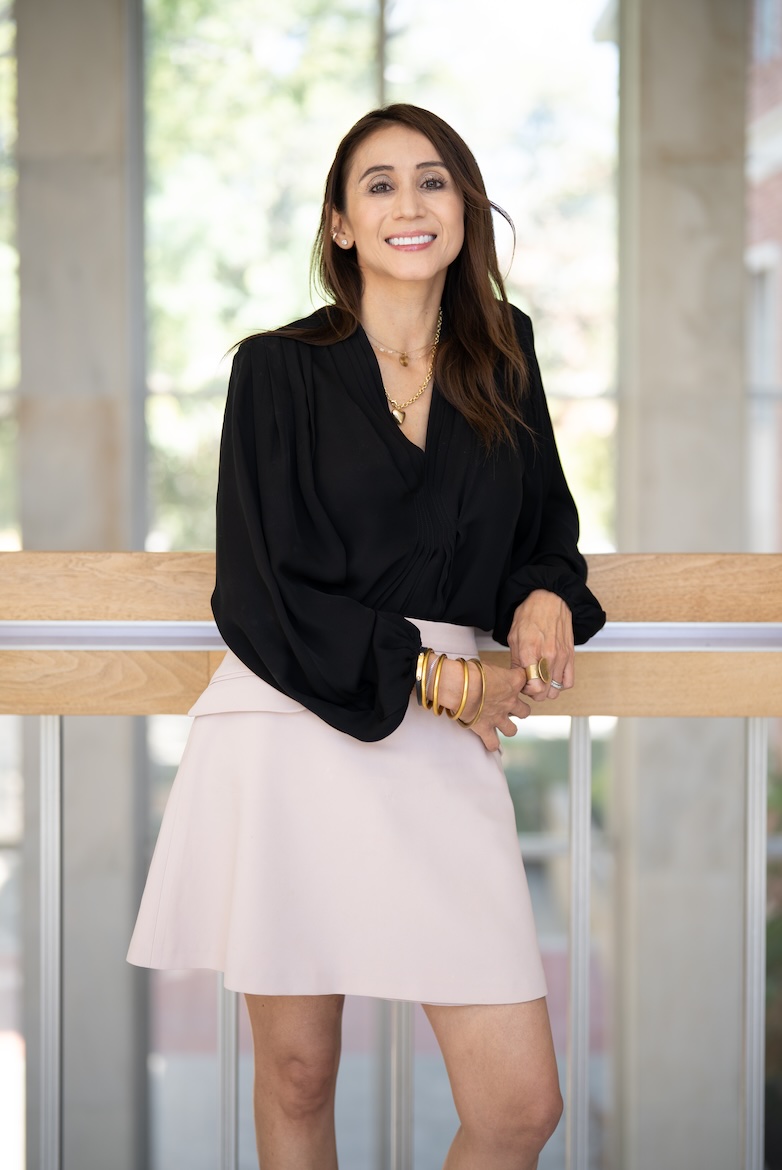
“The ethos of the CDA, and my work as dean and vice provost, are rooted in a relatively simple belief that adolescence is a pivotal period of opportunity to shape positive outcomes for all young people,” Galvan said. “The work of the UCLA College Division of Undergraduate Education is helping move society toward expanding and enhancing belonging, access and all the privileges afforded by public higher education.”
In some cases, that life-changing work has been particularly profound. For example, in 2024, Galván contributed to a landmark decision by the Supreme Court of Massachusetts to categorically ban life-without-parole sentences for 18-to-20-year-olds convicted of homicide. Her expert testimony underscored how the neurodevelopment of young adults in their late teens and early 20s shares striking similarities to that of younger adolescents, particularly when it comes to continued brain development, neural plasticity and the importance of social connections.
The decision opened the door for more than 200 young people serving life sentences to eventually be eligible for parole or resentencing.
Galván is grateful to see the research she began two decades ago have such a tangible, real-world impact on people who may now have a second chance at life.
“One of the most gratifying aspects of being a researcher in adolescent neuroscience is to see your work used beyond the lab,” Galván said. “When that ruling came in, I received a message from the attorney I had been working with. He said, ‘Your testimony just gave 200 young people a chance at freedom.’ I can only hope that my research can continue to be informative for policy-level decisions.”
‘A-ha moments for us all’
Galván’s commitment to expanding life-altering opportunities for system-impacted youth is also reflected in her work with UCLA’s Prison Education Program. This past spring, she taught a Fiat Lux seminar at the Federal Correctional Complex in Victorville, California, examining the impact of early-life adversity on brain development.
“The work of the UCLA College Division of Undergraduate Education is helping move society toward expanding and enhancing belonging, access and all the privileges afforded by public higher education.”
–Adriana Galván
Attended simultaneously by students who were incarcerated and those who were not, the course offered all the students the opportunity to learn from and with each other in a shared educational environment.
The prison did not permit instructors to bring teaching devices or visual aids, so Galván had to re-think her teaching approach. But she cared deeply about the subject matter and the students, and she managed to foster a thriving classroom environment where all the students arrived prepared and eager to learn and participate. They asked questions, shared their lived experiences and, in the process, created a community of people whose lives may not have otherwise intersected but ultimately did — for the benefit of all, instructor included.
“Every moment of that course will stay with me for a long time,” said Galván. “Programs like these are very powerful pathways, and I was honored to teach this class that led to so many a-ha moments for us all.”
That course was transformative for many participants, including rising second-year UCLA political science student Nikolas Opolyar-Warren.
Opolyar-Warren, who has served as a student assistant for the Prison Education Program since his first quarter, cemented his desire to become an attorney focused on criminal defense and civil liberties, thanks to Galván’s example.
“This was my first time taking a Prison Education Program course, and I’m glad I had a chance to take it with Dean Galván,” he said. “She taught us all how education is a form of liberation and how incredibly meaningful it is to make these experiences available to all.”